Check the Evidence Yourself
One verifier, two kinds of evidence: a machine's operational record from AEM Inside, or a person's AI conversation captured with witness. No account required — and no need to take our word for it, because you re-run the checks.
What a Passed Verification Looks Like
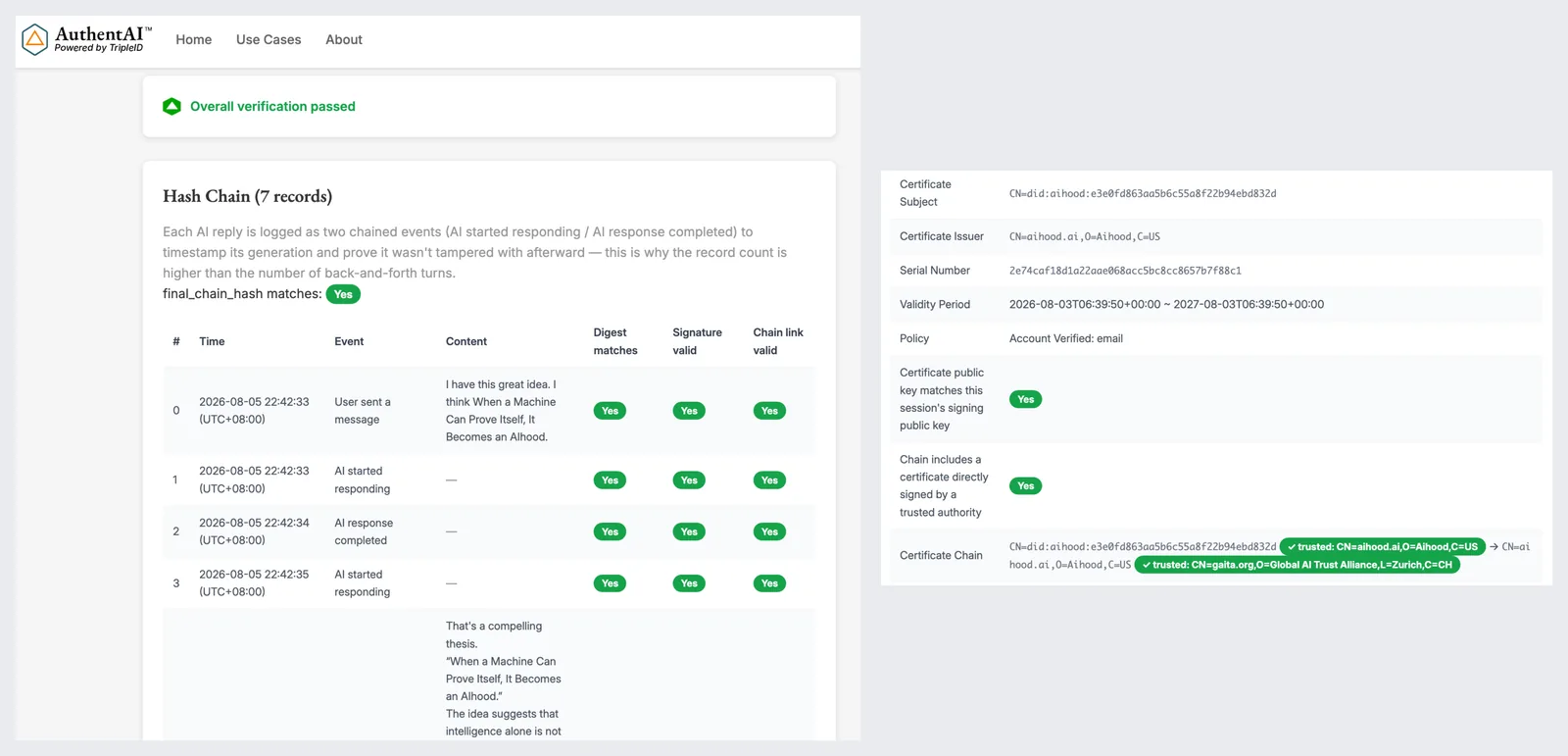
Not a mockup — the verifier's own output for a real witness package.
What Verification Actually Checks
Signatures
Every record carries its own ECDSA signature. The verifier re-computes each one against the key it claims to be signed with.
The chain
Each record commits to the one before it. A break tells you the sequence was cut, reordered or edited after the fact.
The seal
The export manifest fingerprints every file by path, size and SHA-256. A swapped or missing file shows up immediately.
Identity and tier
The result states the assurance tier plainly — anonymous but intact, email-verified, or hardware-rooted — instead of a generic green tick.
Three Possible Verdicts
Verified
Every signature checks out, the chain is unbroken, and the manifest matches every file. What the record shows is what was captured.
Tampered
Something changed after signing. The result localises the break — which record, which file — rather than just failing.
Unverifiable
The package is incomplete, or its signing key cannot be resolved. That is not proof of tampering, and it is never presented as one.
Open the Verifier
The verifier runs on its own domain, verify.authentai.com, and it stays there on purpose. A checker that lives independently of the thing it checks is a stronger claim than one we host beside our own marketing.
Opens verify.authentai.com in a new tab. Verification is free and always will be — it is how evidence travels.
What Verification Does Not Prove
Not when, independently
Timestamps in a witness record come from the signer's own device clock, not a trusted timestamp authority. Every result page says so rather than implying otherwise.
Not whether the content is true
Verification proves a record is unaltered since capture. It says nothing about whether the AI's answer was correct, or whether the conversation was wise.
Not a legal ruling
This is chain-of-custody engineering, not a finding of admissibility. What a court or regulator accepts is their decision, not ours.
Credibility with a sceptic comes from stated limits. Every verification result carries an explicit “what this does not prove” box.
Create Evidence Worth Verifying
witness records a person's AI conversation. AEM Inside records a machine's operation. Both land on the same verifier.